
New Azotic CEO Positioned to Accelerate Company’s Global Commercial Success
June 3, 2025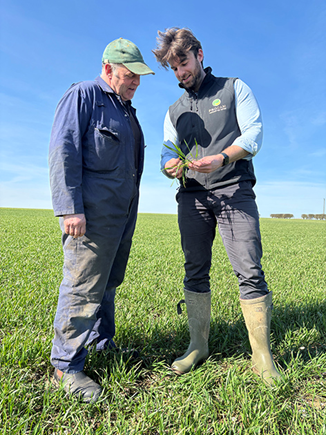
Alternative N lifts yield in Yorkshire
Yorkshire arable farmer Derek Cornforth
Derek Cornforth, will be using an alternative source of nitrogen across his entire winter wheat and oilseed rape area this year following a successful tramline trial in 2025 which boosted wheat yields by as much as a tonne per hectare.
With a straightforward rotation consisting of oilseed rape, first and second winter wheats and winter barley, Derek Cornforth’s mantra for managing his arable land at East Heslerton Wold Farm near Malton is to keep things as simple as possible.
“We drill all of our crops from mid-September onwards,” Derek explains, “including oilseed rape which we don’t drill any earlier to protect it from the main cabbage stem flea beetle migration. OSR is still the best break crop for our location and land, and while it doesn’t always perform perfectly, keeping it in the rotation enables us to grow good crops of winter wheat and winter barley without too many problems.”
Like all farms, the weather is Derek’s biggest challenge, especially as the farm sits at 180 metres above sea level on the Yorkshire Wolds. “We can’t change the weather, so we work hard to keep our chalky soils in good condition which we do by applying plenty of muck from the farm’s B&B pig rearing operation to provide nutrients and some much-needed organic matter.”
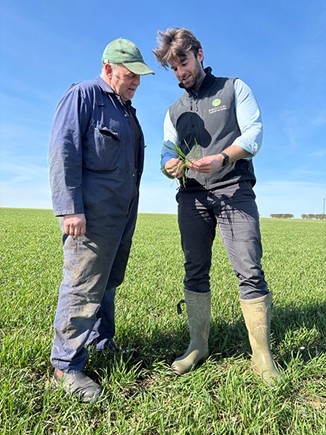
Having worked with agronomy firm ProCam for more than 30 years, Derek is currently advised by the company’s local agronomist, Danny Hatchett. “We get on well with Danny and appreciate his honest approach,” Derek explains. “He’s not afraid of trying to persuade me to try new products or ideas, and while I’m all for trying a new approaches to old problems, I need to be sure it works before I’ll adopt anything new on a wholescale basis.”
In keeping with this philosophy, when Danny recommended an alternative source of nitrogen, Derek agreed, but limited its initial use to a small-scale tramline trial.
How Encera works
“ProCam is the sole UK distributor of a very effective biofertiliser called Encera,” Danny explains. “Unlike granular or liquid sources of nitrogen which must be absorbed by the plant via the roots or foliage, the nitrogen fixing endophyte bacteria in Encera live within the plant where they metabolise atmospheric nitrogen and turn it into available N.
“This makes nitrogen available to the plant irrespective of the weather or soil conditions and negates the risk of nitrogen uptake being limited by excessively dry soil conditions or being leached away by wetter weather.”
To test the performance of Encera
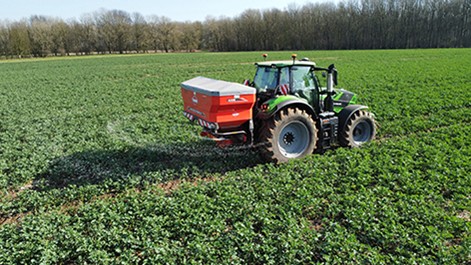
Derek agreed to use two sachets across two tramlines (approximately eight hectares) in a field directly opposite the farm.
“At first the treated area was a day or two slower to progress through its growth stages, but it looked visibly greener and healthier,” Danny explains. “That’s because the treated plants were less stressed by last year’s drought and weren’t racing through their growth stages as quickly as their untreated counterparts. By the summer arrived, the entire field was ready to be harvested at the same time, with the treated area yielding an extra tonne per hectare.
“At a time when the ever-changing global geo-political situation is making input prices so volatile and products such as bagged fertiliser difficult to source, and with the incoming Nitrogen Fert Tax on the horizon, the ability to offset any fertiliser is welcome,” Danny explains. “Encera provides the equivalent of approximately 30 to 40kg of N per hectare which means it can be used to replace a proportion of conventional fertiliser. Thankfully, Derek buys his fertiliser well in advance and got this year’s supply at what, in hindsight, was a good price. That means, instead of using Encera to replace some of his bagged fertiliser, he can afford to stick with his usual application rate and use Encera to provide an additional boost to push yields a little harder.”
Encera, which is supplied in small sachets, also has a smaller environmental footprint compared to synthetic fertilisers which are more complex to manufacture and bulkier to transport.
“It’s also easier and cheaper to apply compared to granular or foliar N,” Danny continues. “As long as it isn’t being partnered with high doses of copper or foliar urea products, it can easily be incorporated into T1 fungicide treatments which means there’s one less pass through the crop. With diesel and labour prices rapidly increasing, that’s another good reason to use it.”
Impressed by last year’s trial
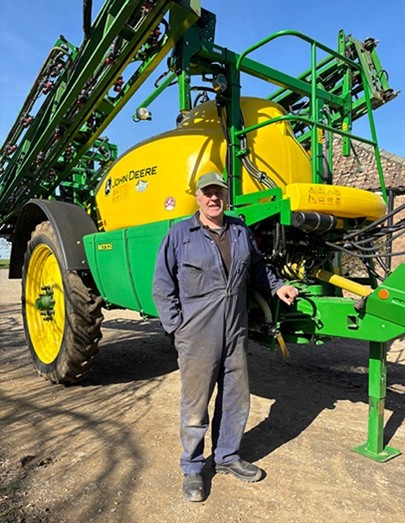
Derek has committed to using Encera across his entire area of winter wheat and oilseed rape in 2026. “I’d like our wheats to yield a minimum of four tonnes per acre,” he describes, “but that depends on how the weather treats us. In the first three months of 2026 we only saw 150mm of rain, so while other parts of the UK have had recording breaking amounts of rainfall, we’re already heading towards a drought. There’s nothing we can do about that other than using products such as Encera to offset the dry conditions.
“At the end of March, we were a week or so behind due to the wet winter which prevented us from travelling, and the crops were about a week ahead, so we’ve been in a race against time to apply fertiliser as soon as possible,” Derek continues. “But even though time is pressing, I’ll purposely withhold Encera from a couple of tramlines so that we can compare performance with and without.
“I’m not going to tell Danny where I’ve chosen not to use Encera because I want to see if the difference between treated and untreated is obvious. It’ll be an interesting exercise and I’m looking forward to seeing what the yield response is this year. Hopefully it will protect us against whatever the weather brings, and help to offset some of the price and supply issues that constantly seem to come one after another.”


